
NEWS
Local Catskills Man Puts His Life on the Line to Bring Humanitarian Aid to Ukraine
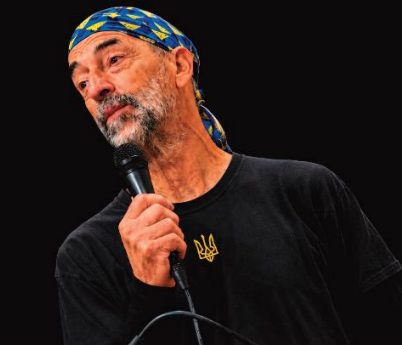
JEWETT — Michael DeBenedetto puts his life and limbs where his heart is for the people of Ukraine. He is not Ukrainian American, his family is Italian American. When Russia invaded a country which had given away its nuclear weapons on a promise of peace, he began to organize aid. "They did not want the nuclear weapons, they were the third largest nuclear power in the world," Michael said. He is heading up an ongoing drive spearheaded by our neighbors, inspired by his selflessness and the needs of the Ukrainian people. They continue to buy medical supplies and vehicles to save lives and defend freedom in a small nation which has been standing up to a corruption plagued superpower. As Michael DiBenedetto puts it, "At the beginning of the invasion, I didn't even know where Ukraine was." He heard Zelinskyy reply to offers of rescue and asylum, "I don't need a ride, I need ammunition."
Some people do need a ride, not to other nations, but out of the kill zone in the DonBas region. Michael is working with Jonathan, a twenty nine year old California man, whom Michael met when they both were working with a group called, "Road to Relief." Michael did not give his last name, and I thought it best not to ask. Today, Michael works with the Adaptive Relief Collective, which has a team of twelve people. They are doing evacuations and delivering humanitarian supplies to Sloviansk and Kramatorsk. There is intense fighting there now, and two of the team members have already given their lives, killed by Russian ordinance. There has been a marked increase of attacks by the Russians on aid workers and first responders, using "double tap" tactics. A short time after an attack, a second strike is sent in to kill those who come with medical aid and to evacuate the injured. Over all, in Ukraine, the United Nations and independent humanitarian networks confirm the deaths of at least 25 humanitarian aid workers including two American volunteer medics. This number would be higher, but the UN and other groups do not count a fatality of an individual who may be a combatant at times and an aid worker at other times.
For Ukraine, defending the two cities, Sloviansk and Kramatorsk is critical. If they fall, Russia will have an open path into central Ukraine. So far, in the Donetsk region, where these Ukrainian cities are found, the official death count stands at 4,336 civilians killed. Jonathan is evacuating civilians with two buses, which are often down, needing repairs. At such times, he uses an ambulance or an armored car. The concert's goal is to raise funds for another critically needed bus. The bus will be filled with medical supplies. Jonathan informed Michael, after one such vehicle delivery, that the medical supplies, donated in the UK to fill the American purchased vehicle, were worth more than the vehicle. At great risk, the aid vehicles are driven to the death zones, the swaths of land which pass for the front lines today, where the Russian military kills anything that moves, a Ukrainian soldier, a dairy farmer or a civilian on a bicycle. The danger was brought home during the concert. A computer conference with Jonathan, and members of his team was set up so the audience could hear him first hand and ask questions. They were attempting to speak with us from a basement, as they were under bombardment. There could not be a stable connection established, so after a few flickering images and a few words, the link was lost.
The concert was held at the Grazhda Ukrainian Community Center in Jewett. It was where such a day must be held. It is an extraordinarily beautiful traditional wooden Ukrainian building next to a breathtaking and beautiful traditional Ukrainian church. The St. John the Baptist Ukrainian Catholic Church is a hand-carved wooden basilica constructed of mortised wooden components without the use of a single nail. I was invited to cover this event by the Catskill's own musical power couple, Justin and Barbara Kolb. Justin took a break from his retirement, or as he puts it, his "rewirement," to play for the fundraiser concert. As I have said about Justin in the past, the kid can play. And play he did.
Barbara Kolb described why she and Justin were there. They "just admire Mike DiBenedetto for putting himself in the position he has, where he goes there and does anything that they need."
Roman Tytla was the Master of Ceremonies for the concert, introducing the acts and playing with his band, "Slug." (Some Local Ukrainian Guys.) I spent 59 years on Saint Marks Place, Manhattan which if it had a number, would have been 8th Street, one block over from Little Ukraine, 7th Street. Roman and I reminisced about the Ukrainian neighborhood which most of the audience had lived in at one time. There were a lot of familiar faces.
After Justin, Olya Fryz took to the stage. She played a traditional Ukrainian instrument, the Bandura and sang in Ukrainian. Many of the songs she sang were introduced by the phrase, "the writer of this song was killed by the KGB." The violent suppression of Ukrainian nationalism by Russia is an age-old story.
Mike told the audience of what it was like to deliver humanitarian aid in a nation where aid workers are hunted, as every man, woman and child is hunted by killer drones. The buses and trucks, desperately needed are not only being taken off the road by overwork in a nation where spare parts are hard to get. They need to be replaced when Russian ordinance blows them up and kills the angels who are seeking to help those in mortal need. In the past few days, this has become even more dire as the American owned and operated Starlink system has been intentionally slowed down so that it no longer can detect Russian ballistic missiles so that Ukraine can intercept those agents of civilian death. The defense of Ukrainian lives is in the hands of remarkable people like Mike and his friends here and on the front line kill zones.
Helping to raise funds were performers Craig Werth, an interfaith minister from New Hampshire, winner of the Canadian Juno Award, the equivalent to the American Grammy Awards. The last performer was Stephen Said. Stephen Said is known in many lands for his songs and his activism. Shortly after Russia rolled into Ukraine, he wrote a song, Glory to Ukraine. He sang it at a rally in Times Square with the Ukrainian Dumka Chorus. He sang it at this concert in Jewett. An audience member spontaneously stepped up on stage and led the crowd in singing along in Ukrainian.
Ukraine is far from our peaceful mountains. Many of my readers, I know, have never been to war. I have thought, how can I convey some sense of the reality of a nation at war. I think Michael says it best, describing his first trip to Ukraine. Near the front line he visited a small village, every house was damaged and many destroyed. One home was completely destroyed, and a woman killed in her bed. He described the town as being about the size of our Lexington, New York.
Let's take a moment to imagine our nation being overrun over thousands of miles of our neighboring territories, the invading army being held at Prattsville and bombarding Lexington. Then think of any of our neighbors, killed in their beds there. Michael goes on to say he saw a man wearing a T-Shirt that said, "we are all in this together." We all know that is how it would be here. Let's extend that "all together" to those far away neighbors in Ukraine.
Always humble, Michael describes his motivation. "I am thankful for the opportunity," to help the people in need in Ukraine. I hope many of his neighbors here in the Catskills take the opportunity to help and donate to save lives at this moment of such need.
To find out how you can help, go to https://www.musicforamissionukraine.org/