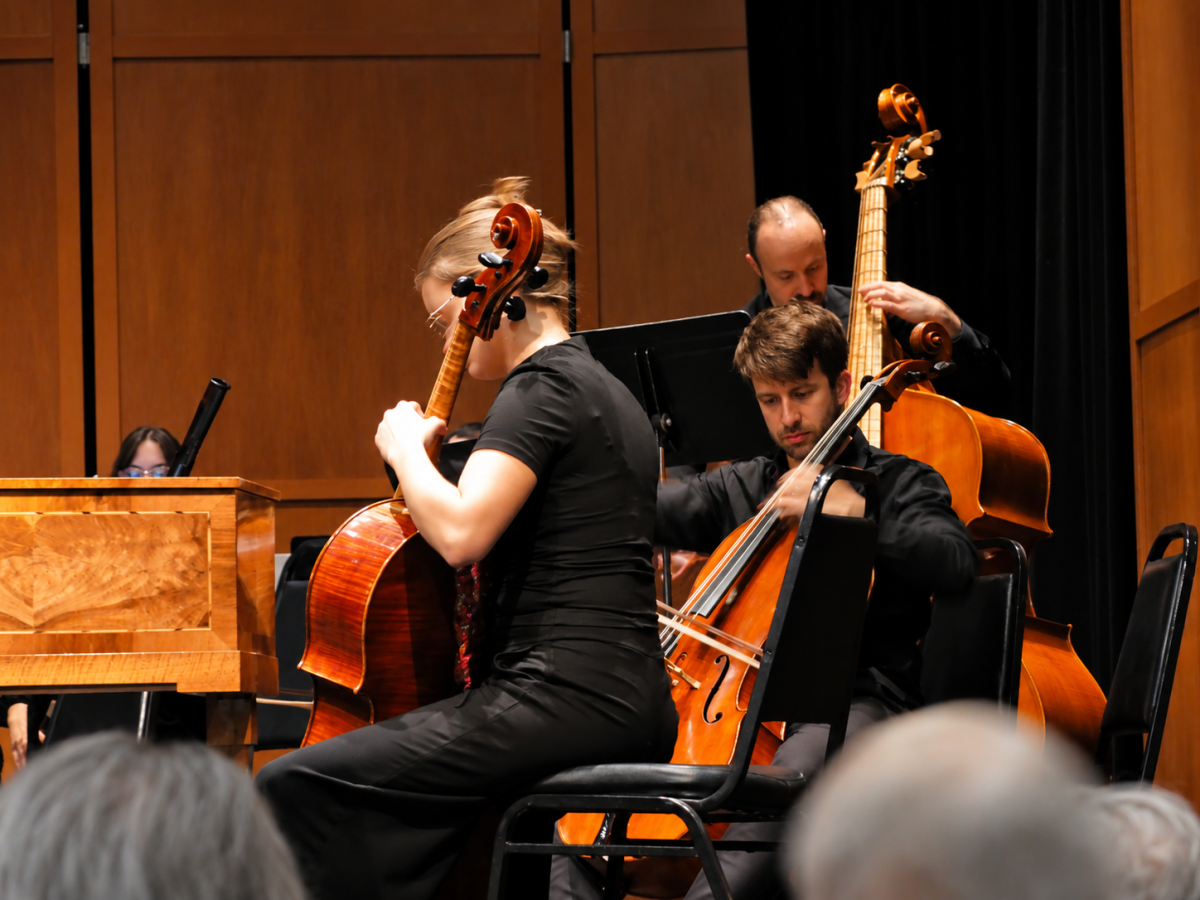
HUNTER - We, in the Catskills have a unique resource which conveyed me and a full house of my neighbors to Europe of the 18th Century. The Doctorow Center's Evelyn Weisberg Concert Hall proved to be the perfect time machine for the journey and the Twelfth Night Ensemble, the perfect crew to work the magic. As you might imagine, time machines are not built overnight, nor are they constructed by just anyone. When John F. Kennedy promised that we'd have people walk on the moon, he did not hire a couple of local welders and a fireworks company. He gathered together teams of experts in every facet of the journey's challenges. In that same spirit, when Peter and Sarah Finn set out to build a time machine in the town of Hunter, they brought a team together who understood how to create sound.
The genesis of this project begins with a fire. In April of 2001, Steven E. Greenstein had amassed a collection of antique pianos. He wasn't the local welder or fireworks company, he was a recognized master of sound and string. His Brooklyn company, Vintage Pianoworks had established a reputation for taking antique pianos and bringing out the sound and physical beauty of their youth through his mastery of instrument conservation and repair. He moved his home, workshop and twenty historic pianos to Samsonville in Ulster County. In 2001, his home, workshop and pianos were lost in a fire. He set out to rebuild his life's work and collection in Accord, NY. There, he brought together an even larger collection, and restored them. Today, his pianos can be seen in the Piano Museum, attached to the Evelyn Weisberg Concert Hall.
Peter and Sarah Finn had a plan. Its baseline theory is outlined in Peter Finn's book "Driven to Build, Guided by Values: Leading for Long-Term Success in the For-Profit and Nonprofit Worlds." In this time of dog eat dog and fake it til you make it business models, the sound in the Evelyn Weisberg Concert Hall is proof that he has a better model. His description of how to be a success, "Cultivate a Culture of Caring, Work Hard and Play Nice" can quite literally carry us back in time, by bringing the talented and the knowledgeable together to create magic moments in magic places.
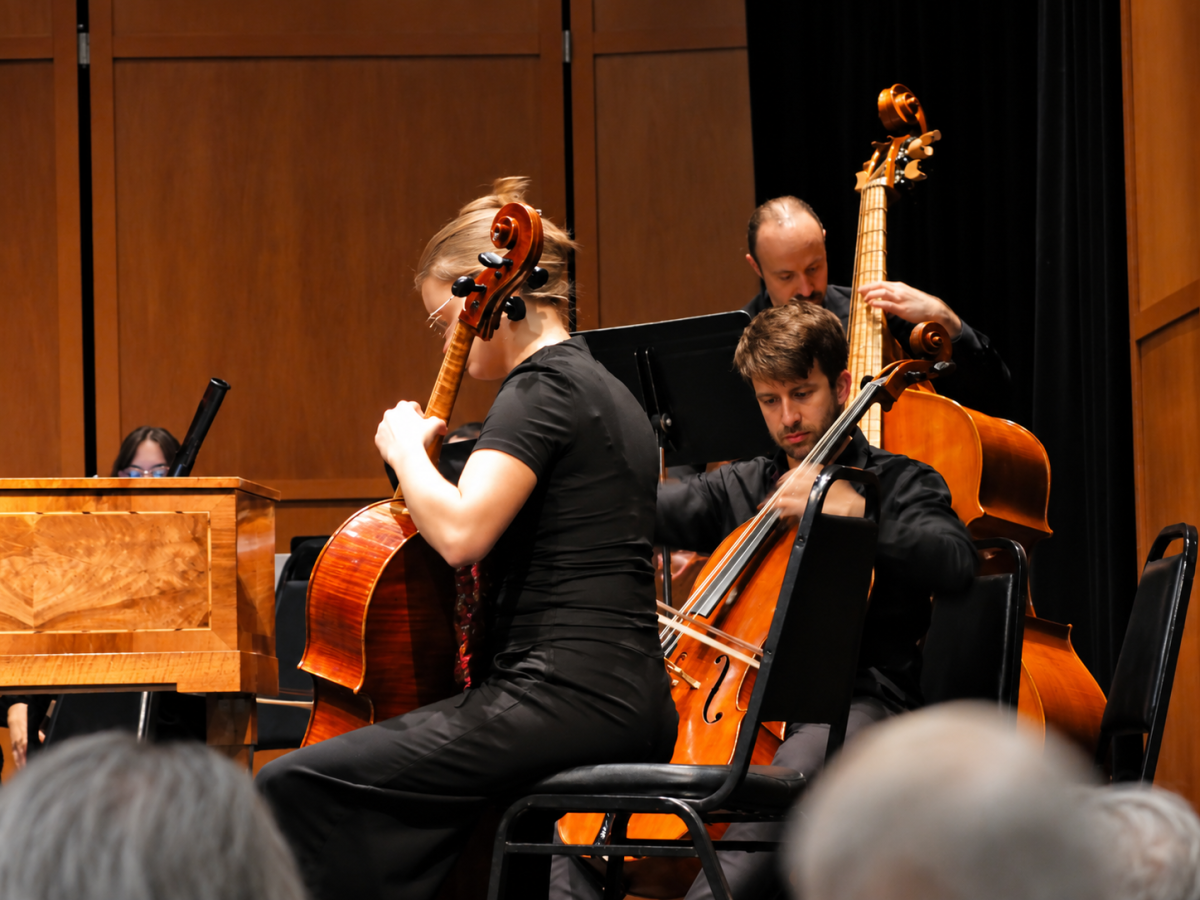
And what a night was had, this night in Hunter. The Evelyn Weisberg Concert Hall is a room alive with sound, and not by accident. In building the stage, the room was reshaped to provide an acoustic environment that projects the sound. After all, what is the good of listening to an historic instrument projected electronically into the room. The room itself is an instrument conveying living sound, not electronic imitation. Closing your eyes, you experienced an evening with Wolfgang Amadeus Mozart and his friend Joseph Haydn, (hence the title of the night's concert "Birds of a Feather") hearing their music as it was heard in the 18th century. The Twelfth Night Ensemble play instruments passed down through the centuries, to achieve an authentic experience of the music in its original intention. I should mention, Giovanni Paisiello was there as well. His Overture to La serva padonna exuberantly began the evening.
The two directors of the Twelfth Night Ensemble, Rachell Ellen Wong and David Belkovski met at Julliard, studying in the Historical Performance division. They and their ensemble are making a reputation as up and coming stars on the concert scene. Adding to the wonder of this night was the brilliant performance by Yi-heng Yang on pianoforte. Hearing Yi-heng Yang live is more than a treat. Her latest recording, on pianoforte with Aisslinn Nosky on violin, "A Richness of Fancy" is receiving brilliant reviews from Gramophone and Strad magazines. Yi-heng Yang performed this evening on one of the Piano Museum's pianofortes, an 1826 Conrad Graf gem, restored by Edward Swenson.
Hearing Mozart and Haydn with a pianoforte rather than a modern piano, is to experience the music in a new light. A modern piano is a much more aggressive instrument. A pianoforte is a peer in the ensemble, blending rather than overpowering, rising out of the whole, at times, but, not dominating the piece. The sound seems halfway between a harpsichord and a piano. There is a difference. Where a harpsichord plucks the string, the pianoforte, like the modern piano, strikes the string. However the strings are lighter gauge than a modern piano. The hammers are made with a lighter felt than a modern piano's hammers, with a leather band where the string meets the hammer. The note seems to end abruptly, a much less "wet" sound. We well may wonder what the composers may have thought, if they could be transported forward in time to hear modern settings of their music on modern instruments. We have the great advantage of being able to listen back in time to the sounds they would recognize.
The humor and approachability of the music and its performance was highlighted by conductor David Belkovski, who turned to the audience after the energetic applause for Haydn's Symphony No.83 La Poule (the Hen) and said, "Clap again if you heard the chicken. The audience clapped again for the oboe's odd interlude which evoked the clucking of a chicken. And approachability is the key to performances at The Evelyn Weisberg Concert Hall and the Piano Performance Museum. Patrons feel equally comfortable to dress in their "Lincoln Center Best" or jeans and a jumper.
One of the thrills of live music for the audience and nightmares for musicians, is that historic instruments have had a long life and the odds that one small piece of these lovingly conserved yet complicated machines may have reached its expiration date. I grew up playing traditional Irish music. Most of us, especially back in the sixties and seventies, before a number of enthusiastic instrument makers began to make new old style instruments, played pre- Boehm system "German" concert flutes. So, where modern flutes go into the shop for new pads, for the most part, between every two to every twelve years, vintage flutes... well, wood may crack, springs may give up the ghost. I was thrilled by the strength of Melanie William's playing. At times her flute, an 1828 5-keyed Clair Godfroy Airé soared over the full orchestra, delivering a rich and wonderful tone. It was a thrill to hear this historic instrument played so well. The fact that it bears a "lion's head" maker's mark, shows it to have been made by Clair Godfroy, the son of Clair Godfroy le père. Clair, the son, began using the five key system, and importantly, using Grenadilla, an African ebony. This made the flutes so famous, they were often counterfeited. So, in 1828, he began using the hard to copy maker's mark. The true test of concert musicianship is what to do when disaster strikes. The spring on Melanie's low D key went the way of all flesh. She played with the missing note with such grace that I am sure none listening but Melanie noticed. Not willing to give up to fate, she asked those around her between pieces if anyone had a rubber band. Remarkably, one musician did. She effected a quick "jury rigged" repair and continued the concert - low D restored. Brava. Clair, mon amie, pourrais-tu envoyer un ressort pour touche « ré » au XXIe siècle, s’il te plaît ?
Twelfth Night Ensemble, we are told in Pam Weisberg's introduction, had spent from Thursday to Saturday in Hunter rehearsing. Of her time in our mountains, Yi-heng Yang says, our audiences are "really warm, really open and enthusiastic. We had a great time up here. The musicians and I loved being here, a retreat. We get to be inspired by nature. It is a great place to be and focus on music.
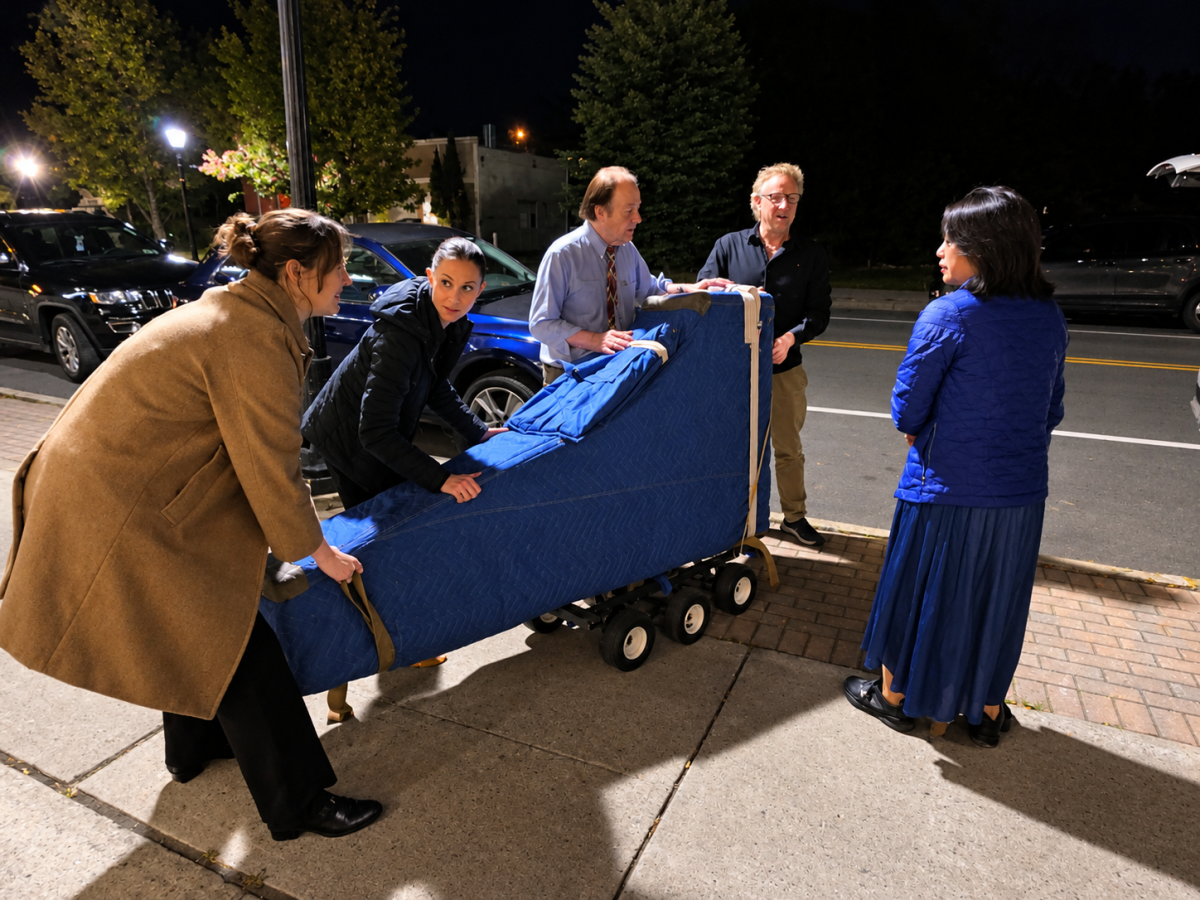
After the reception, I had the pleasure of watching a pianoforte being loaded into an SUV, for the trip to New York to play at the Good Shepherd-Faith Presbyterian Church. My best guess is that it was the pianoforte owned by Yi-heng Yang, as she got into the back of the vehicle to gently guide it into the exact spot where the other end would clear the door. It was one of those moments common to those of us who play large and valuable instruments. We practice and gain proficiency to become slightly underpaid moving companies. The church is a venue associated with Lincoln Center. The community stood up to developer, Robert Moses, and would not let the church be destroyed in the building of the concert complex. The world is better for their resistance. The church was built in 1887–1893 and had been designed by J.C. Cady & Company. The firm had designed the original American Museum of Natural History. Its remarkable design gives the church remarkable acoustics. As a result, today, though it still functions as a house of worship, it is a major venue for chamber music, baroque ensembles, and choral groups.
Dear Readers. We are so lucky to have the gift of The Doctorow Center's Evelyn Weisberg Concert Hall and Piano Performance Museum thanks to the Catskill Mountain Foundation. The next event to carry us away to other times and rekindle our love of the light of liberty will be, "On the Fringes of Liberty." Saturday, November 7th. Jean Bernard Cerin, vocalist; Patricia Garcia Gil, fortepianoist; Eve Miller, Baroque Cellist. They will perform works from France, Haiti, and the United States on the subject of Liberty.