ROXBURY — Dear Neighbors, most know that I love to tell the stories of the people of the Catskills, their tough and creative lives. I love telling these stories because I have over the years had to tell the harder stories. I started in the occupied counties of Ireland in the mid-1970s. I then did general reporting in NYC, from crime to fashion journalism. I photographed fires, arrests, streets blowing up, people fighting and people dancing. The job of a journalist is to be the eyes and the ears of the community. Often, people doing their jobs to save people in pain, feel protective of the people they are helping and I can't tell you how many times EMS or police have asked me as I worked, "would you want to be photographed at a time like this?" I think most journalists would answer, as gently as possible, yes. My wife and I were covered in the press after a particularly violent robbery. And yes, it was important for my community to see us at that very bad time. That's how communities learn the lessons of bad times in our lives.
There are other reasons we have press in society. I always have tried to leave opinion out of a piece and tell the reader what I saw. To be a neutral observer you need to get to know the entire community. Over the years I got to know the shopkeepers, the homeless kids in the park, the firefighters and the police. I'd get calls from officers to cover events they felt the community should know about. More than once, at Punk Festivals in the park, I'd hear my name being shouted by young people being arrested who were challenging the reason for the arrest, and the officer would call "Yeah, Lorcan, photograph this, I want folks to see we did this right!" And when things go wrong, having a neutral observer's work in court is often welcome.
I photographed two teenagers in the park, as they revived a third teen with Narcan. The FDNY EMS attendant shouted at me, as I photographed her working, as she joined the teens in saving the life. At the time, Narcan was illegal for other than doctors or nurses. I interviewed the teen who had given the other the shot. He had been a drug addict, taught how to save lives by a doctor in a clinic, who regularly supplied narcan to young drug addicts. The act of saving lives turned this young man's life around. He got clean, and never left the house without his Narcan kit. I ran into the EMS as she sat in her ambulance, on station. She called me over. She had read my piece on Narcan and apologized and said she hoped it would help make Narcan legal for others besides doctors to carry. I told her I understood her anger and was happy she understood after reading my piece. A few months later she was in one of my favorite first responder photographs. A cab had driven into a Cleaners on 9th Street and 1st Avenue. She and my friend, Officer Gavin were both lifting the long spine board with the cabdriver, together into the ambulance. It was a time when the papers were looking for rivalry at emergencies between the FDNY and the NYPD. I titled the picture, "pulling together."
I photographed a lot of fires. The FDNY knew me and my work. I was covering a fire in Chinatown, and Chief James Savastano beckoned me past the lines, knowing I was press. He could see I wanted to be between the engines and ladders as they were bringing people out of the burning building. I thanked him and included a photograph of him in the article. All of us who knew the Chief were shocked when he died of a heart attack while jogging a few weeks later, and we ran the photograph again. I went to his memorial, and his family and I exchanged Christmas cards for a number of years thereafter. Part of telling these stories is showing the selfless work of Sheriffs, of Firefighters, EMS crews, those who are there on the front line of humanity when needed.
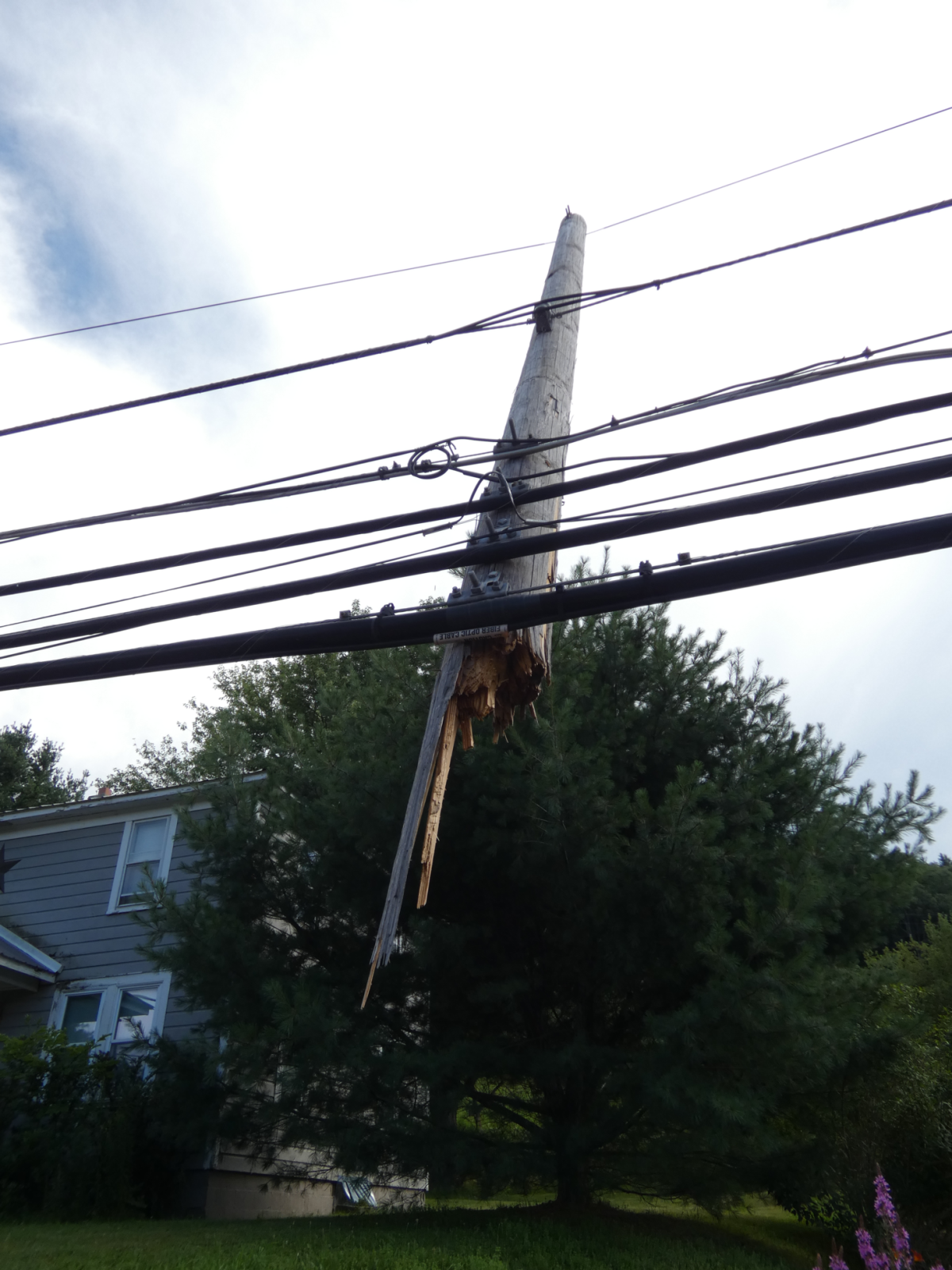
I thought I should start my first hard news story in the Catskills with this, because you all should know it is the worst part of this job we do. Today, just before five, the fire siren sounded. Saying goodbye to friends a few minutes later, I saw the lights on State Highway 23. For much of my life, I've lived with a camera always at the ready. I rushed down, as much as I can rush in my seventh decade. A car had cut through a telephone utility pole and sped through a house's front garden to finally come to rest against a tree. The fact that the front end was detached against the tree showed it had been going fast when it hit the tree, after cutting about ten feet out of the lower third of the pole. I looked for skid marks to see the pattern of braking, and there was a short skid crossing the yellow line towards the pole. So it seems if she did brake, it was a short pump on the brakes, if at all. The damage showed the car, most likely hit the pole going much faster than the speed limit of 35 miles per hour.
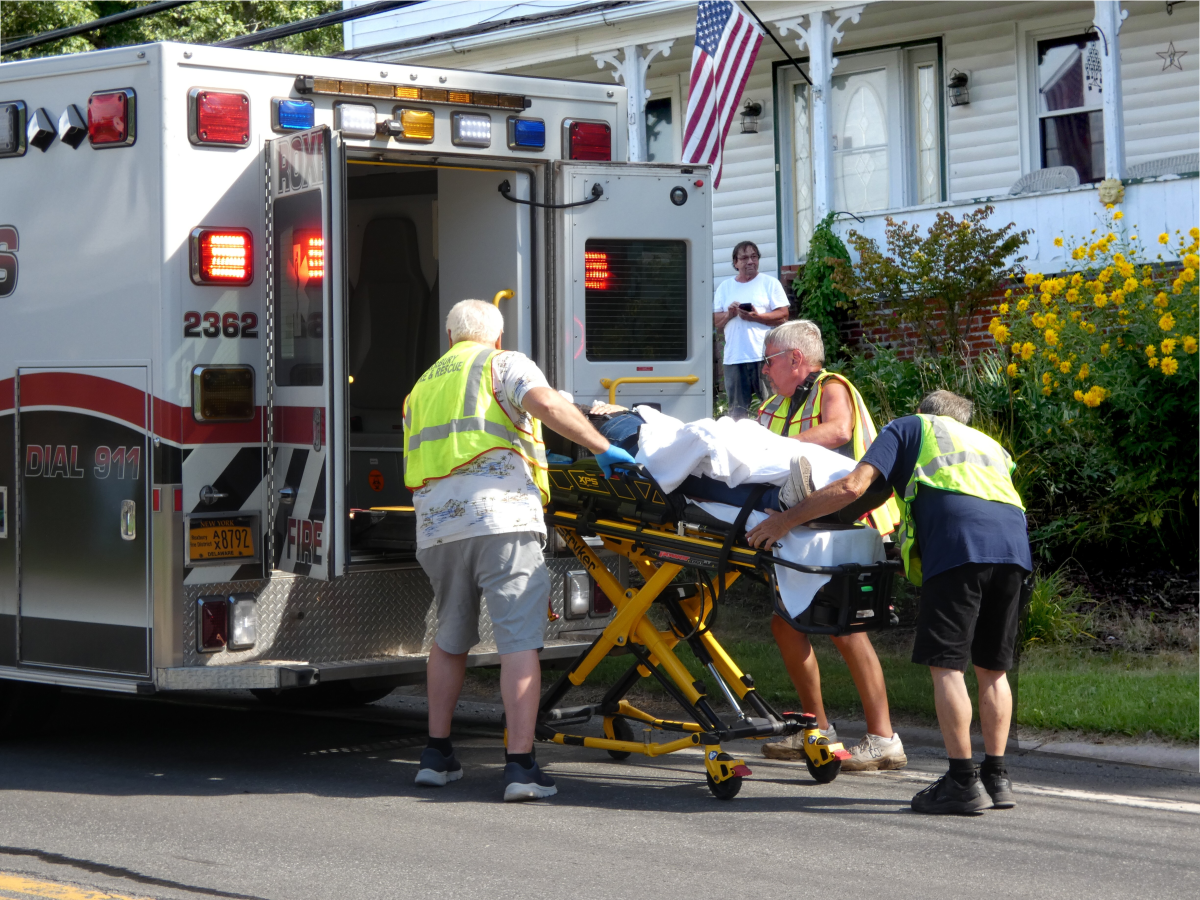
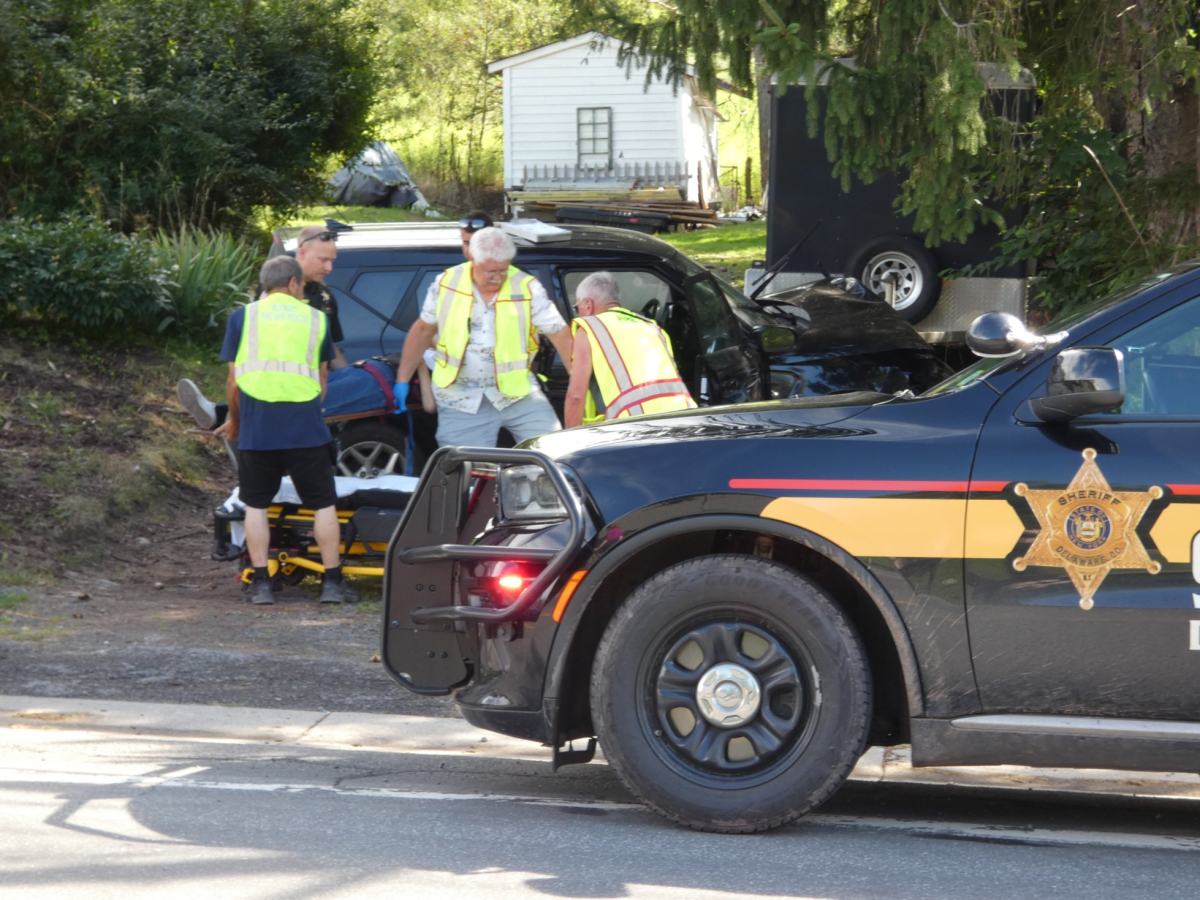
The owner of the property, at 37436 State Highway 23, Milton Ballard, was standing in his plowed up front garden watching. Three members of the Grand Gorge Fire Department were working with two sheriffs and an ambulance crew to gently extract the injured woman who had been driving the car. The EMS crew placed lateral head supports as they strapped her to a long spine board, and lifted her into the ambulance. A sheriff, concerned with her privacy, asked that I not photograph her. In the photograph presented with this story, her entire face is hidden behind the arm of one of the firefighters. This way, the community can see the work the first responders do, and the injured driver is not shown.
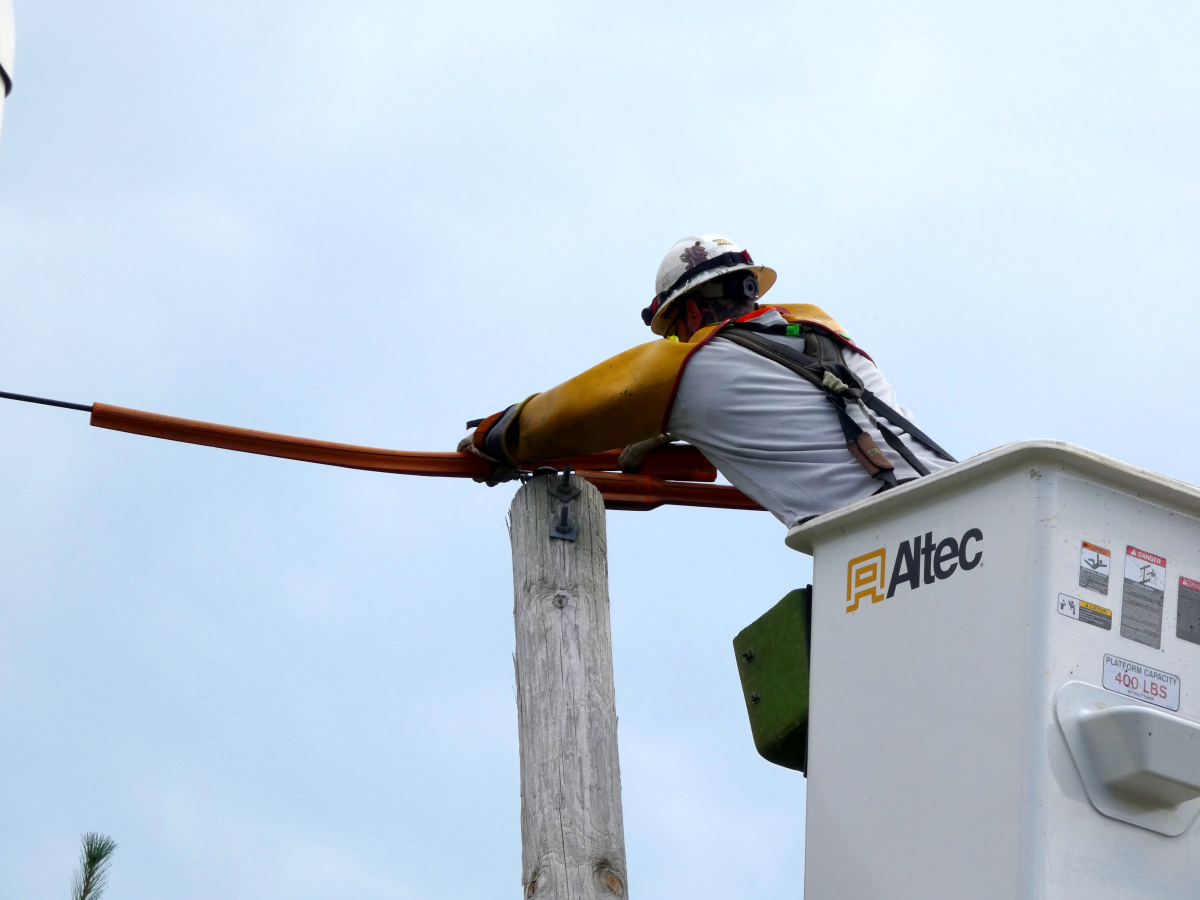
Perhaps a half hour after the initial call, NYSEG had two trucks on the scene. With practiced skill the two workers donned their protective clothing and went up in the two cherrypickers. In a few minutes they had encased the live wires in protective sheaths and detached them from the hanging pole, then they cut the bulk of the pole away, so that the weight of the pole would not part the power lines.
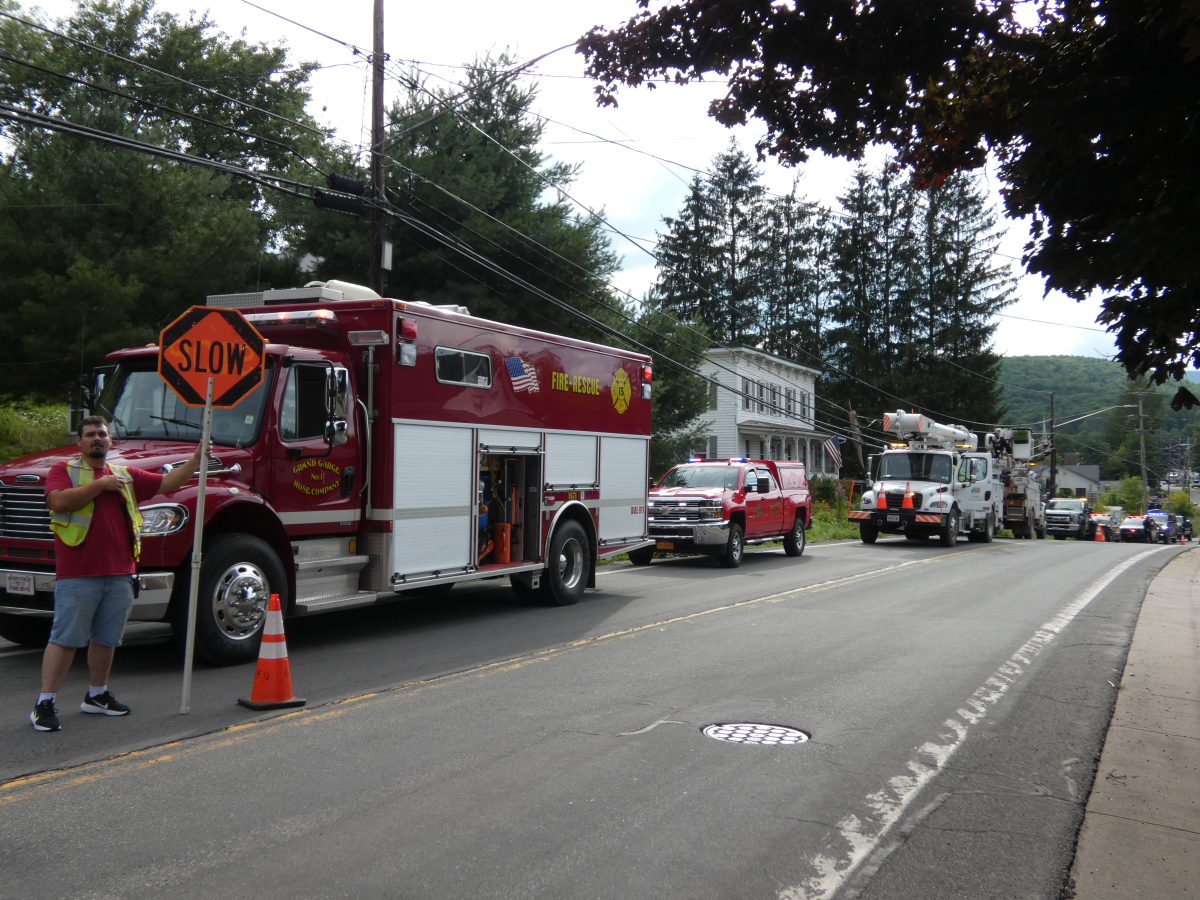
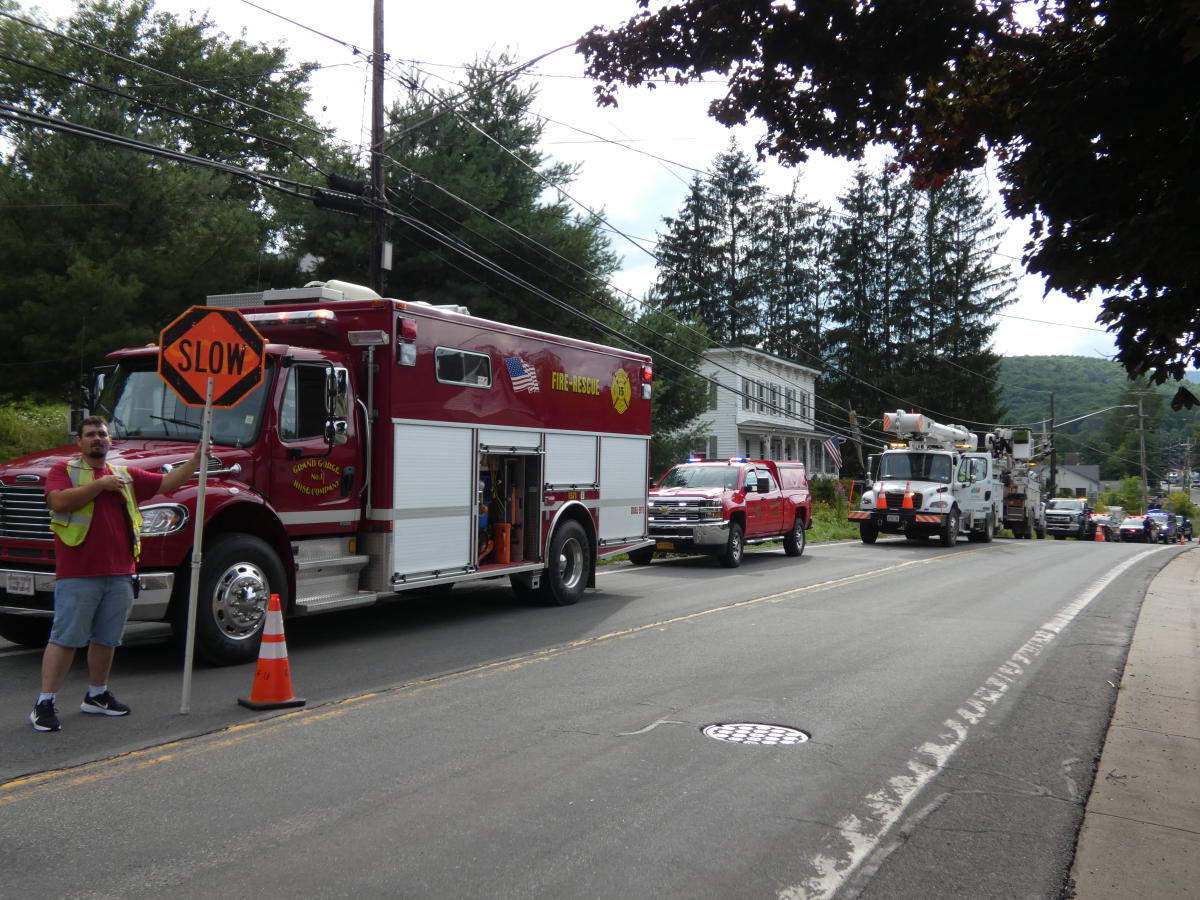
As all this was happening, volunteer firefighters had narrowed the road to a single lane, and sent traffic through in alternative directions in turn, only stopping traffic completely for a short time while emergency vehicles were positioned, and when the pole was removed. NYSEG's crew performed this task with remarkable speed.
My wife and I live on this stretch of road, perhaps 800 feet from the site of the crash. Last week we found our neighbor Larry's cat had been hit and killed in front of our house. It was not the first local pet killed on this road. Few people drive through Grand Gorge at 35 mph. Many don't slow down to 55.
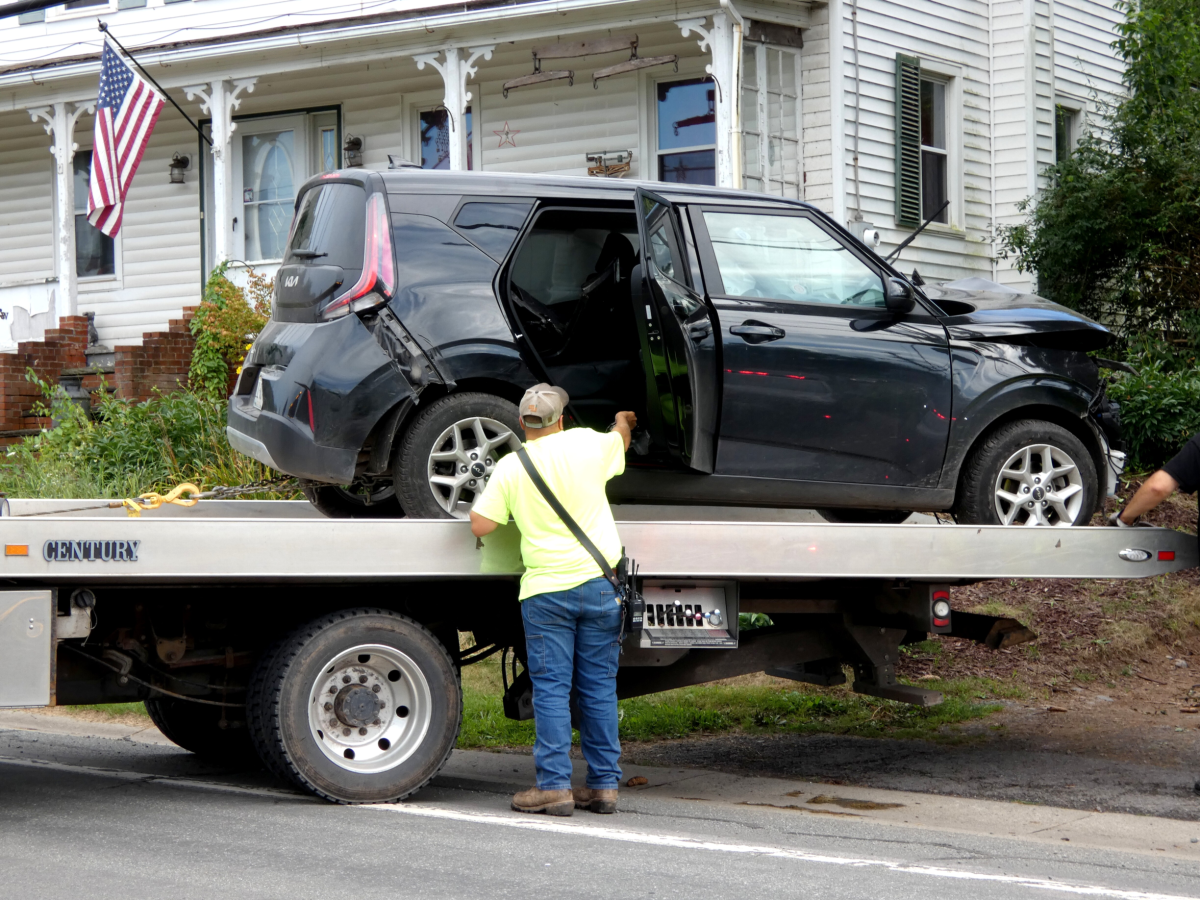
The car was removed by B&D Motors, who did a professional job, and taken away to Arkville. My appreciation to the professionalism and polite direction of the first responders, and my hope that the driver is not badly hurt and that she is fully recovered soon.
Cover Image: First responders keep traffic moving safely as they work to alleviate the danger