
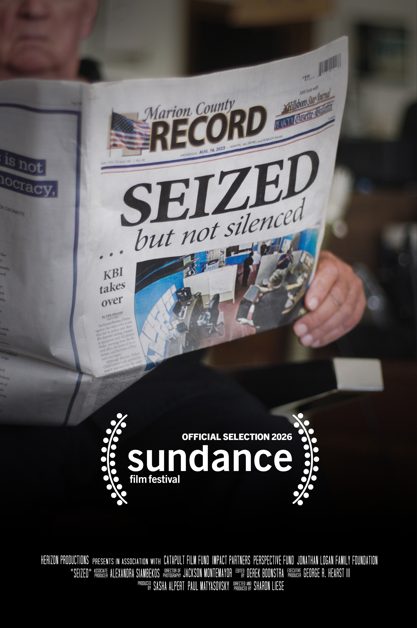
The small town of Marion, Kansas (population roughly 1,900), made international news after police raided the offices of the weekly Marion County Record on August 11th, 2023. The brazen raid, led by power-drunk, corrupt police chief Gideon Cody, who'd grown suspicious of the newspaper's reporting, extended to the home of the paper's editor and owner, Eric Meyer. Body camera footage from the raid shows Eric's 98-year-old mother and newspaper co-owner, Joan, upset, telling the officers in her home, "You know, if I have a heart attack and die, it's all your fault... If I die, you're going to be sued for murder." Joan Meyer died the following day.
The incident caused shockwaves over the alarming and dubious assault on the freedom of the press and its constitutional protections. Eric Meyer became a cause célèbre in journalistic circles, and Gideon Cody and the Marion County Police Department became symbols of Trump-era attacks on the press, proof that the rhetoric had real-life consequences, as the quiet Midwestern town of Marion squirmed in the spotlight.
Filmmaker Sharon Liese had the chance to turn her lens on Marion for a deeper look in the award-winning 2026 documentary Seized. By allowing everyone involved to tell their side of the story, Liese created a balanced, often funny film that cuts through the headlines and noise to reveal the nuanced human stories behind the controversy. It also highlights the challenges small-town American newspapers (like The Mountain Eagle) might face.
The Palace Theater in Albany will host a free screening of the film with a panel discussion on Nov 7th, presented by Times Union CEO George Hearst III, the film's executive producer. Seized will be streaming on HBO this December.
I spoke with Sharon Liese on Zoom in late October, shortly after the film won the Changemaker Award at The Woodstock Film Festival.
Bradley Towle: Thanks for meeting with me, and congratulations on the Changemaker Award.
Sharon Liese: Thank you. Yeah, it was quite a surprise and an honor.
BT: You've been making documentaries for at least a decade?
SL: It'd be 20 years, maybe now.
BT: What's different now from the way it would have been maybe 10 years ago or so?
SL: Well, when people talk about contraction, it's definitely real. I feel like there just aren't as many streamers or outlets that you can go to to sell your project. Funders are being bombarded by all of us filmmakers because we all want to do our work and need support, so it's been very challenging. I feel very, very fortunate I was able to raise enough money to finish the film and have HBO pick it up. But it's tough out there right now.
BT: I remember this story [about Marion] in the news, and I imagine other filmmakers were orbiting it as a project. Was that the case?
SL: That's really interesting that you bring that up, because that was my reluctance at first. I thought everybody else was going to be wanting to do the story, and I didn't know if I wanted to get in the scrum of that, so I hesitated. I grew up in Saratoga Springs, but I live in Kansas, about two hours away from Marion. I didn't know how close I was to Marion; I never even heard of Marion. But I heard about it on NPR when I was driving, that this raid had just taken place, and I was like, "It's in Kansas, so can't be that far away." It's not my typical type of story to tell, because I usually do a story that's off the radar; something nobody else is looking for. I made a film called Transhood where I followed five trans, non-binary kids for five years, and no one knew I was working on it. I mean, it's a big topic, and lots of themes that reach out into the world, but I was just sort of quietly doing my work.
So, when this happened, I was like, "Wow. I don't know," because everybody's going to want to do this. Then I found out I was only two hours away, and I realized that their equipment had been seized, so you couldn't email them or get them on their cell phones, but I could drive there. So, I drove. Then I met with Eric, the editor, and he is a very old-school journalist, and he said, "You got here first, you get the scoop."
BT: Wow, so because they were cut off, your proximity to it was really the way that you were able to get to it.
SL: I think so. There were news outlets and media that got there, and they got there quicker, but, you know, documentary filmmakers, they didn't get there. There were others that came along. I know that because Eric told me that there were people that were kind of hounding him for it also.
BT: If this had been a fictionalized version of this story, I think Finn would have come across as an invented character, an audience surrogate, to take us into Marion. Was the timing luck? That this new person was arriving?
SL: Yes, I would say a big part of it was luck. Deb Gruver, one of the reporters at the paper, whose phone gets ripped out of her hand in the body cam footage, left the paper because she was quite traumatized by the event. I knew that Eric was looking for a replacement. He has this one big requirement: you have to live in Marion, Kansas. So it's hard to attract someone who, first of all, can do the job and, second, might want to live there. So, he was looking, and I thought, "Well, this might be part of the story that he's been sort of left in the lurch with not having a reporter in this position." I kept saying, "If you're going to interview someone, I would like to film that. Just keep me posted." About a year later, I called him on a Sunday, just to check, and he goes, "Oh yeah, I have a new reporter starting tomorrow. He's from New York City; he's a recent grad from Chicago." I'm like, "Wow. Okay, I need to get a crew together and come there tomorrow." So, we did it really, really quickly, and I don't know that it would have worked if I didn't have his first day, so I was glad we were able to do that.
BT: As an audience, it's a great guide through the world.
SL: Yeah, because he was kind of like us and the viewers, going, "What is happening here?" The only thing I knew when we got into the edit was that I wanted to flash back and start the story with Finn. The editor really liked the idea, and we never changed it.
BT: As I watched Seized, I started thinking about these movies from the 1970s. I thought of Harlan County, USA. You know, going into this small town that's kind of torn apart by some controversy. I thought of All the President's Men because of the importance of the newsroom; The Settlers' Day Parade kind of reminded me of Robert Altman's Nashville. But the situation, the raid, seemed explicitly Trumpian to me. And I'm wondering if you feel like this could have happened at any other time in American history.
SL: I mean, it definitely seems like it's of the moment that this would happen, and when I first started to tell this story, I did feel like it was a canary in the coal mine. Now, three and a half years later, it's unfortunate, but it seems like it's happening all the time. So, I do feel like it's of the moment. However, we talked in the edit about journalists being under attack; it's nothing new. This sort of attack, though, and the empowerment and the ease with which they just thought, "Well, yeah, we can do this," just seemed very current, and did seem emboldened by the current administration.
BT: Did you ever feel unsafe when you were there?
SL: I did go to Gideon Cody's house once. It was way out on a dirt road. There's the stand-your-ground law, so when I rang his doorbell and he said, "Go away!" I thought, "Oh, I better go away." But I left a note on his truck, actually, and said, "I'm not the media; I'm a documentary filmmaker. Call me." And he did call me after I was down the road. He only wanted to talk; he didn't want me to come back. But I felt a little unsafe then. I didn't want to go over the speed limit.
BT: On the topic of the police involved, I thought it was really interesting that you got the officer who was involved with executing the warrant.
SL: That was Chris Mercer, who spoke toward the beginning and was upset about his pension.
BT: It was interesting to me that he was willing to participate in the film. I felt like he saw it as an opportunity to plead his case. Was it difficult to get him to talk? I could tell he wanted to, but I can also understand if he was apprehensive.
SL: You're picking up on all the really interesting, big decisions that we had to make. So, it took a year for people to talk about how they didn't like the Record. People thought we were hired by Eric to come in and do this, and there were all kinds of rumors that we only wanted to tell one side of the story. We were like, "No, we want to tell all sides of the story. If you have something to say, we want to hear it." It took a really long time until my producer, Paul Matisowski, spoke to the mayor, and the mayor said, finally, after, like, three meetings, "Alright, I see that you're trying to tell a broader view of what happened here." And once he came on board, he got other people to come on board.
However, Chris Mercer was a last add. We had already gotten into Sundance, and we were finishing the film. We were close to lock cut, and he reached out to Paul and said that he wanted to do an interview. And at first, I was like, "Oh, I don't know. What's he going to say that's going to add to anything?" And then, we said, "You know, we said we would listen to everybody, so we're going to." So, we went and did the interview, and we were like, "Wow." So, where we put it in the film, it feels like it's kind of early on, and his emotion feels like it's early on, but that was really like two years after. And a lot of people say, "Wow, are you kidding me? You think you had it worse?" And there are some people that say, "It must have been really hard for him," because he did just stand by.
BT: They picked the wrong small-town newspaper guy.
SL: Oh yeah.
BT: The second they showed up, he was like, "You don't know what you're doing."
SL: Right. Do they know what the Kansas Shield Act is? I don't know. Even if they do, there is this sense, which is just a whole other conversation with law enforcement, that if the judge signed the warrant, you just have to carry it out.
BT: What does Eric Meyer think of the film?
SL: The only person I showed it to who's in the film before we went to Sundance was Eric, because I thought he ought to see it. He doesn't always look the best in it, so I was a little anxious. I drove to Marion, put it on his big screen, and we watched it. He was happy with it. He said it was very different than he expected. He didn't expect all the humor. I don't think he expected that we would have as many people as we did who would actually talk about what they didn't like about the paper. But he respected it because he's a good journalist and understands you want to tell as many sides as possible.
BT: I can't imagine there are many people like him left.
SL: I know. When we do Q&As, he likes to be able to tell one more beat of the story. So, he'll always be like, "well, you know, it really wasn't exactly…" or, "you know, that person actually then got fired." Eric likes to have the last word.
BT: What about Finn?
SL: Finn is great. He was at Woodstock, so that was really wonderful. He did an internship with The New Republic, and now he's doing a fellowship at The Washingtonian in DC. I hope this film gives him some visibility and helps his career. It's always a nice little byproduct if your film can help the people in it.
BT: Thank you for taking the time to talk to me. It was a pleasure.
SL: Thank you so much.
