Showing 10,261–10,272 of 13,912 articles
By Matthew Avitabile
DCHA - Saturday, April 8 @ 2 pm Join the Delaware County Historical Association at 2pm on Saturday afternoon, April 8 for a PowerPoint presentation delivered by railroad historian, and trustee of the Greater Fleischmanns Museum of Memories, John Duda. John will be highlighting the more unusual railroads in our region. Admission to the event is free. For more information, please call (607) 746-3849, or email: dcha@delhi.net
By Matthew Avitabile
A baseball/softball skills clinic was held for area youth last weekend at South Kortright Central School. The event was sponsored by the Catskill Mountain Little League and was attended by over 40 children who learned fundamentals from the South Kortright varsity baseball team and longtime Coach Bob VanValkenburgh. CMLL will sponsor another pre-season clinic on Saturday, April 8 from 10am-12pm at the Grand Gorge Civic Center. The clinic will be led by Coach Nate Fish who has many years of coaching experience from his time in professional baseball. The event is open to all area youth ages 7-12 years old. No pre-registration is required.
News
By Matthew Avitabile
News
By Matthew Avitabile
News
By Matthew Avitabile
News
By Matthew Avitabile
News
By Matthew Avitabile
News
By Matthew Avitabile
News
By Matthew Avitabile
By Matthew Avitabile
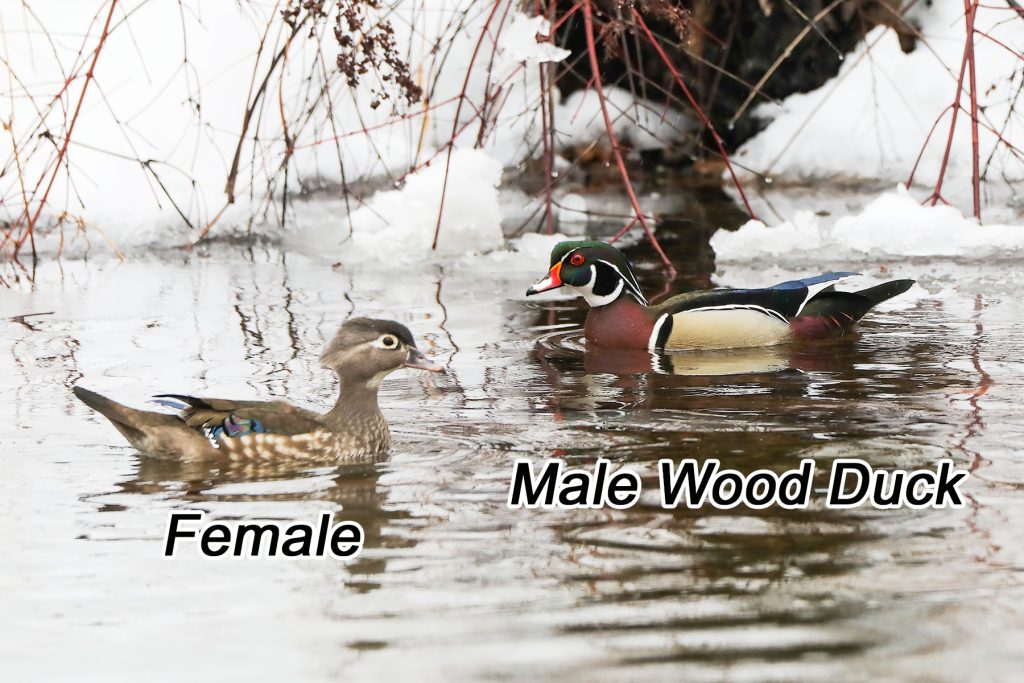
By Bill Combs Jr Welcome to On the Wild Side. Join me as I explore the wildlife and nature that Schoharie County and the surrounding areas have to offer on the wild side. Spring has arrived and so have the migrating birds. We spotted 1 immature Golden Eagle in the area around Max V. Shaul State Park and 2 immature Golden Eagles flying around Mine Kill State Park. Look for a large bird with a black tail with a white band near its body and triangle shaped white patches on its underwings. It is a rare treat to spot this many in the same general area as they have not nested in New York in over 40 years. We also spotted two about this time last year around the same area. One of the most colorful migrating ducks is the Wood Duck. We found them along Route 30 as you head south out of the town of Grand Gorge. Look for them in the beaver ponds and shallow marsh areas on the east side of the road near the edges of the water. Wood Ducks are one of the few species of ducks that nest in a tree. The males are more colorful than the females. They like the edges of the water and hang out in small groups. While you are in the Grand Gorge area check out the Catskill Scenic Trail for hiking or bike riding. Heading west toward Stamford look for the Mase Cold Spring Wetlands Preserve as it is a beautiful hidden treasure to relax and watch the wildlife in the area, you won’t be disappointed. Keep an eye out for Hooded & Common Mergansers, American Black Ducks, Ring-necked Ducks and Mallards as these will also hang out with the Wood Ducks. We also spotted a few Snow Geese, a Lesser Scaup, American Kestrels and a few Wild Turkeys trying their best to walk through the deep snow. We also came across an Eastern Meadowlark. After this last snowstorm I am sure it wishes it would have waited a few more weeks before traveling to Upstate New York, as Meadowlark live in farm fields, grasslands, and wet fields. They hunt for grubs, worms and insects in the ground which could be difficult this time of the year with the frozen ground, but will switch to seeds, corn and wild fruits in the wintertime. Look for a light brown bird with black marks and a bright yellow chest that has a bold black V on its chest. They are medium-sized songbird with a short tail and long bill. On the Eagle Trail these past few weeks they have had a lot of snow ending up their nest. All the eagles in the area are now sitting on eggs and all of them have survived the recent snowstorms. There are some immature and sub-adult Eagles still in the area looking for a mate and maybe looking for a place to call home. If you do happen to come across a Eagle nest please remember to keep your distance, do not hang out around the nest and be as quiet as possible to make sure they have a successful hatching, as they are very sensitive this time of the year. I have had up to 40 deer out in the fields at the same time and have encountered a good many of them crossing the roads this time of the year as the snow melts off the corn fields and the green grass starts to grow back; they are on the move. As you travel the roads and hiking trails of our beautiful and unique countryside keep your eyes and ears open, you never know what you may see or hear.

By Matthew Avitabile
THE CATSKILL GEOLOGISTS BY PROFESSORS ROBERT AND JOHANNA TITUS We try, as often as possible, to show you interesting structures and features that you can go and see for yourself in our regional bedrock. We will do this again in this column, but this week’s effort will definitely be above average. Take a look at our first photo. We are, once again, down in the bottom of Harvey Kite’s Opus 40 quarry. That vertical wall of bluestone is a joint fracture probably exposed by long ago work when this was a functioning commercial quarry. Back then that wall of rock likely had a pile of rock debris banked up against it. We are guessing that Harvey Fite cleaned it up and exposed this surface. All that quarrying broke the rock along a very old joint. We spoke of joints last week. They are vertical fractures in the bedrock that date back often hundreds of millions of years. Those rocks were compressed probably when the African crustal plate collided with North America. That was perhaps about 390 million years ago. Later Africa split from our continent and drifted away, off to the southeast. That’s when all that compression was reduced, and the bedrock expanded and cracked along these joint planes. Take a good look and you will see a very distinctive feature. It is called a plumose structure. This is a common fracture pattern associated with jointing. You can see prominent and concentric fractures radiating upwards. They produce a rippled appearance to the joint surface. You have to look carefully, but there are more shorter radiating structures below. The effect is to produce something that, as the name implies, resembles a bird’s feather. Take a look at our second photo, courtesy of Wikimedia Commons. Those are two real feathers and like the geology, they are shorter below. The similarity is obvious but strictly coincidental. What on earth is going on here? Geologists interpret these structures as having formed at the very moment of jointing. Stresses had been building up for long periods of time and then the rock gave way and the jointing occurred. Somewhere along the line we recall hearing that the fracturing radiated through the rock at the speed of sound. We can only guess, but there must have been an ear-splitting cracking sound. In the end, these are just humble fractures, but they have quite a history. We wonder what Harvey Fite knew and thought of them. He cleaned off this exposure. Was that to make it part of his art? Contact the authors at randjtitus@prodigy.net . Join their facebook page “Tye Catskill Geologist.” Read their blogs at “thecatskillgeologist.com.”
