News

Latest Articles

Reporting from across Schoharie, Delaware, Ulster, and Greene Counties

Showing 10,153–10,164 of 13,912 articles
SUNY Cobleskill President gets Fulbright Award

SUNY Cobleskill President gets Fulbright Award

By Matthew Avitabile

Dr. Marion A. Terenzio, the President of SUNY Cobleskill, has been awarded a Fulbright U.S. Scholar Program Award in Agricultural Education to France for the 2023-2024 academic year. Her project aims to establish a network of higher learning institutions in New York State to advance agriculture throughout the state and develop collaborative initiatives with the National Research Institute for Agriculture, Food and Environment (INRAE) in France. The Fulbright Program is the U.S. government’s flagship international educational exchange program, and Dr. Terenzio is one of over 800 U.S. citizens participating in the program next year.

· 301 views
A Look at New York State Comptroller's Office Audit - Stamford Central School District

A Look at New York State Comptroller's Office Audit - Stamford Central School District

By Matthew Avitabile

By Liz Page The recent release of an audit by the New York State Comptroller's Office (OGS) cites the Stamford Central School District for overestimating appropriations during the time of the audit from July 1, 2019 to Sept. 30, 2022. It also cites unnecessary fund balance and exceeded the statutory limit for surplus fund balance.This resulted in the District levying more taxes than needed to fund its operations, states the report. The audit lists the key findings of the audit, as follows: The Board overestimated appropriations from the 2019-20 through 2021-22 fiscal years by an average of $1.4 million (14 percent) and planned to use fund balance to cover operating deficits when the District realized operating surpluses. Surplus fund balance exceeded the 4 percent statutory limit in two of the last three fiscal years by approximately $700,000 (6.8 percentage points) and $1.9 million (18.7 percentage points). Four of the District’s 11 reserves were not reasonably funded, or used to pay related expenditures, during the last three fiscal years. For example, the retirement contributions for employees' reserve balance of $602,749 was sufficient to cover expenditures for five years. Two expenditure accounts had overestimated appropriations totaling more than $100,000 in two of the last three fiscal years, as follows: Board of Cooperative Educational Services (BOCES) services were overestimated by an average of $373,047 (54 percent), with variances ranging from $339,687 to $406,406. Health insurance premiums were overestimated by an average of $281,916 (14 percent), with variances ranging from $114,600 to $401,667. The Superintendent, Business Manager and Board President told us that the budget variances for BOCES services were due to the uncertainty of knowing how many students might require these services each year. While the costs for BOCES services can fluctuate depending on the needs and number of students enrolled in the program, officials must monitor this expenditure to help ensure future appropriations are more realistic. The audit recommends the board adopt realistic budgets and appropriate fund balance only when needed to fund operations, to reduce surplus fund balance to comply with the statutory limit and use in a manner that benefits taxpayers and to adopt a written reserve policy that establishes optimal or targeted funding levels. "The district generally agrees with the findings and recommendations within the report, however, the district would like to offer a few observations to add context," states Dr. Glen Huot, superintendent at SCS in response to the audit. Dr. Huot said he welcomes the audits. He said the reality is that the audit was done during an unprecedented time of a global pandemic, with school districts all across the state dealing with the same issue related to Covid-19. "It was a two-year period of time where nothing was normal," said Huot. The District also appropriated a fund balance for reserves for capital projects. SCS is currently planning a $7.3 million project that was approved by the district voters. $2.7 million in capital reserve is earmarked for that project. The dates for the audit, states Huot, made it particularly challenging to respond to the Comptroller's audit, due to the uncertain nature of school funding during the global pandemic, the resulting financial impact and simultaneous emergency relief measures at the state and federal levels that were being debated (and later executed). There were warnings for school districts to plan for 20 to 30 percent reductions in state aid and to plan for substantial deficits in the coming year. SCS is heavily reliant on state aid and districts were warned to prepare for serious fiscal problems before they arrive. "We appreciate the audit response relative to the district's reserves and agree with the report's determination that the capital, liability claims, property loss, repair, tax certiorari, retirement contributions for teachers and insurance reserves were reasonably funded. The district feels to prepare for an unanticipated event, such a global pandemic which resulted in thousands of job losses in the state, that the unemployment reserve was adequately funded (as well as retirement contributions, accrued liability, workers compensation reserves, ect.) The district will evaluate these reserves and consider the recommendations in accordance with the audit report.

· 262 views
DCHA to Host History Conference in May

DCHA to Host History Conference in May

By Matthew Avitabile

DCHA to Host History Conference Making History in Delaware County, Saturday, May 13 - 1pm to 4pm Members of local historical societies, local historians, and interested members of the general public are invited to attend the Delaware County Historical Association’s seventh Biennial Historical Conference, Making History in Delaware County. The conference is specifically designed for the town and village historical societies and local historians of Delaware County. For 2023 we have created an afternoon’s agenda focusing on various topics of interest to historians and historical organizations. Presenters will include Mary Liz and Paul Stewart, co-founders of the Underground Railroad Education Center, and Claire Lovell of the South Central Regional Library Council (SCRLC). Claire will explain the SCRLC’s NYS Heritage website and how to upload images there. The conference ends with a round-table discussion concerning local history and historical societies. All sessions will provide for questions/answers and we invite input and participation. Attendees are asked to bring questions of concern for your society for the round-table discussion, as well as dates of planned events, and handouts/brochures which can be shared for cross-promoting. We are looking forward to an informative and enjoyable afternoon and hope that you will be able to attend. Advance registration is requested by May 6, 2023. There is no charge to attend. Please contact us via phone or email: Tel: (607) 746-3849 Email: dchadelhi@gmail.com DCHA: 46549 State Hwy. 10, Delhi, NY 13753.

· 340 views
Opus 40 - More Geological Finds

Opus 40 - More Geological Finds

By Matthew Avitabile

THE CATSKILL GEOLOGISTS BY PROFESSORS ROBERT AND JOHANNA TITUS Opus 40 – Little Balls of Mud. We have been exploring the quarry at Opus 40, near Woodstock in recent months. This is just the sort of thing that geologists do all the time. We visit a new location and just poke around, seeing what we can see. You can’t do this without finding all sorts of interesting things and we have been describing many of these during the past two months. But we always find problems as well. And indeed, that was the case at Opus. Take a look at our first photo. It shows some things that troubled us. Do you know what a conglomerate is? That’s a sedimentary rock that is largely composed of pebbles and cobbles. Often, they are rounded from having been rolled around in the river currents. And that is exactly what our photo seems to show. But, what, we asked, were cobbles doing in a river channel deposit? Where had they come from? How did they get there? River channels like these should be filled with sand and little else. You can see that this was, indeed, a problem. We couldn’t figure this out so we just went on exploring. And then it happened, in a flash, something scientists commonly call the “ah hah” moment. Take a look at our second photo. There you will see more of our cobbles. But the knife joins two which show a lot more. Suddenly we had our ah hah moment. Take a look; can you figure it out? We will give you ten seconds . . . 10, 9, 8, 7, 6, 5, 4, 3, 2, 1 and ???. Well, this is what we think we are looking at. These two rounded cobbles had been broken open, exposing cores. The cores of those two “cobbles” are bits of petrified mud. They likely eroded out of a muddy upstream river bank way back during the Devonian. Sometimes geologists call such things mud blebs. Those mud blebs were caught up in the river currents and rolled around until they had become rounded. Then they encountered a sandy stretch of the old river and then a coating of sand adhered to the sticky muds. You can see that on our photo. And, presto, there we had our “cobbles” and there we had our explanations. This is not great science. The discovery of the polio vaccine? That was great science. The discovery of mud blebs? Not so great. But, like all science, this was a lot of fun! Contact the authors at randjtitus@prodigy.net . Join their Facebook page “The Catskill Geologist.” Read their blogs at “thecatskillgeologist.com.”

· 311 views
Snyder Family Surveying Business Lives On

Snyder Family Surveying Business Lives On

By Matthew Avitabile

Snyders Build Family Legacy, Surveying Business By Bradley Towle MIDDLEBURGH — When Rudy Snyder began surveying in the early 1960s, his three children, Jim, Betsy, and Meg, were still very young. The elder Snyder received his license in 1967 and eventually founded the Rudolph D. Snyder L.S., P.C. in 1991. Rudy Snyder’s foray into the surveying profession opened pathways for his children and established what would become the family business. In the late 1970s, Jim’s friend informed him he was leaving for Colorado, and Jim thought he would also make the westward journey. Upon learning of Jim’s planned departure, Rudy asked his son about joining the family business. There was an increasing amount of work in the area, and Rudy found the occupation financially rewarding and an enjoyable way of life. To obtain a license meant apprenticing for six years, so it was no small commitment. Jim accepted the offer and stayed in Middleburgh. After graduating college in 1978, Betsy Snyder Dupont entered the business as a researcher and rodman. The nature of the job, a mix of outdoor and office work, made it the “right fit” for Betsy. “Every job is unique,” she says. She committed to her six-year apprenticeship and obtained her license in 1985. Meg Snyder Corradino did not start in the family business as early as her siblings. She had a career in advertising but, around 1996, decided she was ready for a career change. The timing was right. The trio’s mother, Janet, was reaching the end of her days running the office, and Meg’s part-time work soon folded into a full-time job working with her brother and sister. While Jim and Betsy are often out in the field, Meg has focused on research. “Everyone brings something different to the table,” she says. Meg sees their work as putting together a puzzle, with all three siblings collecting the pieces needed to ensure they do each job accurately and well. “It’s gotta be right before it goes out the door,” says Meg. More than forty years later, Jim, Betsy, and Meg continue to run Snyder Surveying from their Middlebugh office. The trio wears many hats as a surveying company, from researchers of historical records, representing clients at local planning boards to amateur naturalists. On my initial visit to their offices, Jim showed me some of the Chaga mushrooms he had foraged while conducting a land survey. He took me on a tour of their library, showed me local family relics dating back to the late 1700s, and described surveying, what has changed and what has not. Flood certification tops the list of things he’s seen increased demand for. The career has provided Jim, Betsy, and Meg with varied experiences and deep knowledge of the region. “We have explored the surrounding area more than most and met people from all walks of life,” says Betsy. While the Snyder siblings speak highly of their chosen occupation for its variety (the uniqueness and history of each property keep life interesting), Jim, Betsy, and Meg all agree on one more thing— they genuinely enjoy working together. “It’s all good,” says Meg. “And it’s been fun working with family.”

· 304 views
Huntersland FD 75 Year Celebration with Assemblyman Chris Tague

Huntersland FD 75 Year Celebration with Assemblyman Chris Tague

By Matthew Avitabile

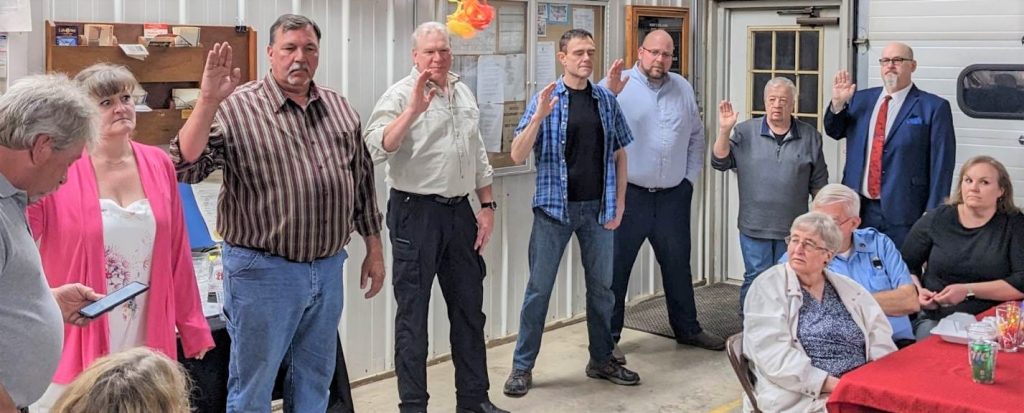
Huntersland FD Celebrates 75 Years HUNTERSLAND - The members and families of the Huntersland Fire Department celebrated 75 years of service last week. Assemblyman Chris Tague recognized Huntersland with a citation as well as members Albert Porter for 45 years of service, Frank Fuchs for 58 years of service and Harold Guest for 69 years of service. "We thank the membership, our auxiliary and you, our supporters for 75 years of dedication. We look forward to the challenges ahead." The officers for the year were also sworn in. They are: * Chief - Michael Walsh. * 1st Asst. Chief - Matt Miller. * 2nd Asst. Chief - Randy Barber. * 3rd Asst. Chief - John Funicello. * President - Matt Miller. * Treasurer - Frank Fuchs. * Secretary - Loucinda Walsh. * Property - Rich Hildebrandt.

· 327 views