
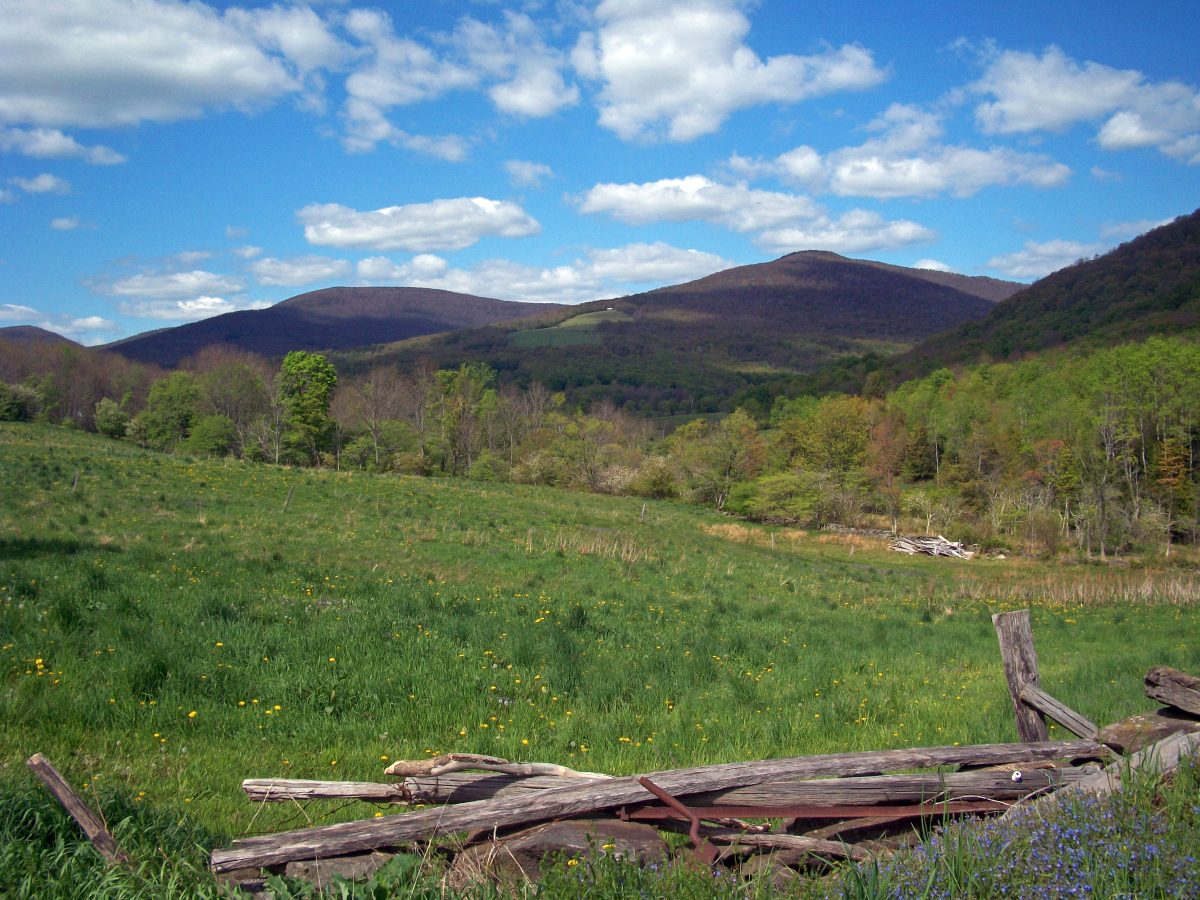
HALCOTT — Nestled deep in the Catskill Mountains, the Town of Halcott stands as one of Greene County’s most distinctive communities—a quiet valley ringed by peaks that has preserved its rural character for generations. With a population of 249 according to the 2020 U.S. Census (down slightly from 258 in 2010), Halcott remains a place of isolation by design, where the pace is slow, the views timeless, and the connection to the land runs deep.
Locals pronounce it “Hawk-it.” Visitors tend to say “Hal-cot.” Longtime resident Margaret “Peggy” DiBenedetto says the pronunciation is one quick way to tell who’s from here.
A biologist who earned her degree in Texas—the only time she lived away from Halcott—Peggy returned and now works for the New York Department of Environmental Conservation in land management. “This is wonderful,” she says. “I get paid to hike, and Greene County is my favorite place in the world, especially for hiking.” Through an ecological lens she observes the land and vegetation of our local valley. She is also the author of two books: “Silver Dollar Girls”, about a young woman who flees New York City during the coronavirus pandemic to her family’s Catskills farmhouse and discovers her great-grandmother’s secret diary as a World War II pilot, as well as her children’s book “Ebony Bear: A Nurturing Ursine Learns a Lesson”, in which a mother black bear teaches her three cubs to navigate the wilds.
The earliest settlement date documented in 19th-century county history is 1809, when Helmus Chrysler cleared land and built a house in the valley. In 1813, John P. Van Volkenburgh, his brother Peter, and their mother crossed Vly Mountain and moved into the dwelling Chrysler had built, marking what the historical account identifies as the beginning of Halcott's first permanent settlement. Earlier attempts to settle the area, dating to around 1790, had apparently been temporary. The area had long been a Munsee Lenape and Esopus tribe hunting ground. Historical accounts from the late 19th century identify a character named Froman as the last Native American resident of the valley. He lived near a spring where the Halcott Center road crosses the Delaware County line, fishing the clear streams and hunting until the encroaching farms and the “rattling of the white man’s implements of agriculture” drove the deer away. One morning, the stories say, he “followed his shadow” and was gone. There is no marked grave recorded in the county histories; local retellings sometimes place him just outside the town line.
Originally part of a larger settlement connected with Lexington beyond Hunter, Halcott broke away in 1851 and took its name from Greene County Sheriff George Washington Halcott. The state legislature formally recognized the new town the following year, in 1852 and the first town meeting was held on April 6, 1852 at the dawn of Halcott.
What makes Halcott unusual even by mountain standards is its geography. It is part of Greene County yet cut off by the Catskill ridges from the rest of the county by paved road. “It’s unusual that residents have to drive all the way around the mountains for an hour in order to reach their County seat in Catskill,” Peggy observes. Shirts sold in town capture the spirit of the place: the front reads “You can’t get here from there,” and the back says “You can’t get there from here.”
For generations those mountain crossings were possible, if difficult. An 1867 Beers atlas map shows five roads leading toward Vly Road (now associated with Bouton Road), the early center of the settlement. Former Halcott Town historian Audrey Johnson noted in a 1972 report that the road network dated back to the 1820s. Local historical research published in “The Times of Halcott” by Pattie Kelder (2021–2022), drawing on maps, photographs, oral histories, and earlier accounts, reconstructs the principal routes:
Turk Hollow Road was the "dance road." It climbed up into Lexington and on toward Westkill. Longtime resident Virgil Streeter remembered taking a horse and buggy over it to official town dances. At the top there was even a little Grange lean-to where folks could rest. It was still listed as a public road in 1956, but by the late 1960s the woods had taken it back. Today Condon Hollow is closed as a through-route.
Mead Road was the "town road." It forked off toward Lexington village, linking families to Beech Ridge Road and the main Route 42. It’s one of the routes you can still see traces of today.
The old Vly Road didn’t follow the creek like it does now. It cut straight across open fields toward the Bouton family farm and the old cemetery. You could still spot it for years because the cows kept walking it, and it was too steep for a plow to erase.
Halcott Mountain Road connected the end of County Route 3 with County Route 2 in Lexington, heading down toward Route 23A near Mosquito Point. Parts of this one are still in use, just with new twists and turns.
Researchers looked for a fifth road over Bearpen Mountain* toward Vega, but maps from 1867, 1960 and aerial photos from 1959 don’t confirm it — it may have just been a hunters’ or logger's path.
Precise opening and closing years for every road are not always recorded. The network existed by the 1820s and appears clearly on the 1867 map. Horse-and-buggy use continued into the early 20th century. Upper Turk Hollow was still regarded as a public road in 1956 and saw some use as late as the 1950s, but by the later 1960s nature had taken it back. A 1967 proposal for a modern six-mile (or alternative longer, gentler-grade) highway linking County Routes 2 and 3 was surveyed but never built, amid questions of funding, politics, and right-of-way through the Forest Preserve. A scenic-route idea under the Highway Beautification Act of 1965 also went unrealized.
The roads were abandoned primarily because they became too difficult and expensive to maintain for the traffic they carried. Steep grades, erosion, winter snow, and the decline of mountain farms reduced their purpose. Farming—especially dairy, hay, corn, goats, and cows—dominated life well into the mid-20th century; 35 operating farms were still counted in 1948, with Peggy's own father still having skin in the game until the 1960s. As farms closed, the remote connections lost their economic reason for existence. Hurricane Irene in 2011 washed out sections of modern roads (including parts of Route 3 near the cemetery and edges of Mead Road), but the older mountain routes had largely faded through overgrowth and disuse decades earlier. In 1982 the town considered whether to restore any of the old roads; many residents declined, favoring the quiet and peace of remaining cut off. “We want to keep this place rural, very slow paced,” Peggy says.
Today the Grange Hall still stands—a former creamery built in 1889, purchased by Greene Valley Grange No. 881 in 1914, and listed on the National Register of Historic Places. It once hosted hundreds of town meetings, extravagant Christmas parties and pageants with children’s choirs, abundant food, and even an appearance by Santa Claus supplied by the nearby Fleischmanns Fire Department. The old Virgil Streeter convenience store doubled as the post office; local beekeepers sold honey there. “The post office ended up closing in 1985 and merged with Fleischmanns changing its original 12437 ZIP code to 12430. ”Most amenities—gas, library, restaurants, fire department—now come from neighboring Fleischmanns. Halcott's United Methodist Church remains one of the community's important gathering places, with a long history of worship and Sunday school. On a quiet weekend, Peggy notes, “you might see only 50 cars in an entire weekend here in town nowadays.”
Most residents today are retirees drawn to the isolation, peace, and quiet. A few still work and commute into Ulster or Delaware counties.
When asked about some of the more recent noticeable changes throughout the years to the town Peggy cites “Hikers pass through more often,”.“The surrounding mountains make us a popular destination for that of course”. While remembering the COVID-19 property boom of 2022, Peggy recalls visiting strangers often knocking on locals' doors asking if anyone would be willing to sell a house to them or land to build one on. Halcott was also the first mountaintop town in Greene County to receive fiber optics for high-speed internet that no longer relied on satellites in rural areas.
Even Hollywood found its way here briefly. Jim Jarmusch’s 2019 zombie comedy “The Dead Don’t Die”, starring Bill Murray, used the old Grange Hall (dressed as an abandoned creepy gas station) for several weeks of filming in the area. Peggy’s brother-in-law Christopher’s cows were supposed to appear but refused to cooperate when it came time to chase the star around. Nearby Fleischmanns and other Catskills communities also hosted scenes.
When asked what there is to do for fun, Peggy lights up: “We love the snow!” Snowmobiling is a big part of our culture out here, allowing travel over trails that cars can no longer use. Locals head to abandoned ski centers such as No Name and Bearpen to explore and hang out.
Peggy and her husband also collect spring water from Vly Mountain (which looms over the town and feeds Vly Creek) to bottle and sell in New York City. Her family has held the property for generations under a conservation easement “to keep the place pristine,” which they intend to leave to their grandchildren. “This place is in our blood,” she says. Each of her siblings lives on the property. She watches the next generation climb the same stone walls and trees she once climbed as a child.
The farms, valleys, and fields, Peggy insists, “all look exactly the same as they did when I was growing up.” She compares Halcott to the legends of the Scottish village of Brigadoon—a mysterious and idyllic place ordinarily enshrouded by clouds high up in the mountains where residents keep to themselves away from the woes of the world, only appearing to mortals one day every 100 years. “That is what Halcott is for us locals,” she says.
“We cherish our isolation in this town,” Peggy remarks. “We actually prefer being cut off from the rest of the world as it has worked like a time capsule to preserve the small town.”
In an age of constant connection, Halcott remains a bastion of deliberate quiet—content to stay just out of ordinary reach.
