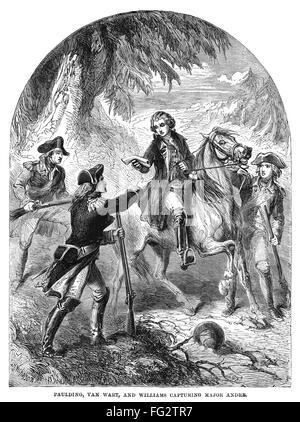
David Williams. John Paulding, and Isaac Van Wart are best known for capturing the British officer Major John Andrè on September 23, 1780 in Tarrytown as he traveled to British lines in New York City with intelligence given to him by Benedict Arnold.
Williams and his wife Nancy Benedict Williams along with their eight-year-old son David Jr. moved to Livingstonville, Schoharie County from Westchester County in 1805. Nancy and David are interred at the Old Stone Fort by the David Williams monument.
Williams, Paulding, and Van Wart were celebrated as heroes during their lifetimes in ballads, poems, plays and monuments and praised by George Washington, Alexander Hamilton, the Marguis de Lafayette, and Thomas Jefferson.
The depiction of Paulding, Williams, and Van Wart in popular culture unfortunately reached its nadir during the third season of the television series Turn: Washington’s Spies, which first aired in 2016. André’s captors are portrayed as ruthless Skinner thugs mugging the charming John André and demanding a reward from Lieutenant Colonel John Jameson of the Continental Army for turning André in. Paulding even steals André’s boots and wears them to Jameson’s continental outpost while poor André is forced to walk barefoot. It’s more fiction than fact.
Some of the myths that are associated with the capture of Andrè in Turn: Washington’s Spies:
Myth 1) Robert Rogers led the captors to Andrè to settle a beef he had with Andrè, and told them that they would be paid a large sum for turning Andrè in.
Reality: Rogers had nothing to do with the capture of Andrè, and he may have been in Canada at the time.
Myth 2) The captors mugged Andrè and found the papers given to him by Arnold in his socks while they were in the process of stealing his boots.
Reality: Andrè wrote two letters to Washington (Washington refused to meet with him) and one letter to his commanding officer Sir Henry Clinton and never once complained that he had been robbed or mistreated by the captors. He had been disguised in civilian clothes, so he requested linen and a uniform. He never asked for a pair of boots.
Myth 3) The vision of large reward motivated the captors, and they demanded a reward for turning Andrè in to Lieutenant Colonel Jameson.
Reality: The captors turned Andrè over to Jameson and went on their way. Jameson did not even mention their names in his letter to Washington informing him that John Anderson (Andrè’s pseudonym) had been captured.
Without the diligence of Washington, the story of the unnamed captors would never have been told.
Washington asked to meet with the captors to interview them personally. Only Paulding could be found at first. Eventually Jameson found Williams and Van Wart and they joined Paulding at Washington’s headquarters at Tappan.
Myth 4) Paulding and Jameson had a contentious relationship, marked by Paulding demanding money and Jameson responding that he could have bread and beer.
Reality: Jameson wrote in a letter to Washington: “This will be carried to you by John Paulding, one of the three men who took Major Andrè and nobly refused” any sum that Andre offered.
Myth 5) The captors were Skinners, pillagers who preyed on civilians regardless of allegiance, during the war in the neutral ground of Westchester County.
Realty: The captors were members of the First Westchester Militia and had performed extensive military service before the capture of Andrè.
Myth 6) Benjamin Tallmadge revealed the true story of Andrè’s capture before Congress in 1817, claiming that Paulding “is not a hero.”
Realty:
Tallmadge had guarded Andrè for the eight days before his execution. He repeated a story that Andrè had told him, stating the captors stopped Andrè to rob him, searched him looking for plunder, and rejected Andrè’s bribe out of their own self-interest, expecting a lucrative reward for turning him in.
Tallmadge was not an eyewitness to the arrest of Andrè and the captors did not even know the real identity of their prisoner. The press ridiculed Tallmadge for trusting the word of an enemy spy over the judgement of Washington.
No where is this dim portrayal of Andrè’s captors is it mentioned that Tallmadge’s superior officers, Jameson, Alexander Hamilton, and Washington met with the captors and praised their actions.
Congress responded by awarding the captors lifetime pensions and ordered that a silver medallion memorializing the capture be struck, the Fidelity Medallion. Washington presented the Fidelity Medallion to the captors two years later at a ceremony at Verplank’s Point. It is the oldest military decoration in United State history.
Washington expressed his pleasure at Congress’s decision as “evidence of the generosity of Congress, a flattering tribute to the virtue of those Citizens, and must prove a powerful incitement to others to imitate their example.”
The three men responsible for foiling Benedict Arnold’s plot are largely forgotten or maligned. During the 250th anniversary of the American Revolution we should try to revisit the story of André’s captors in a fair manner that will do them justice.